
Introduction
Test cricket has several rules that make it different from shorter formats, and the follow-on is one of the most interesting. It allows the team that bats first to ask the opposition to bat again immediately if it has built a sufficiently large first-innings lead. For fans following Test cricket through Wolf777, understanding the follow-on can make scorecards and match situations much easier to understand.
The decision can influence the tempo of a Test and sometimes put one team under significant pressure.
What Is a Follow-On?
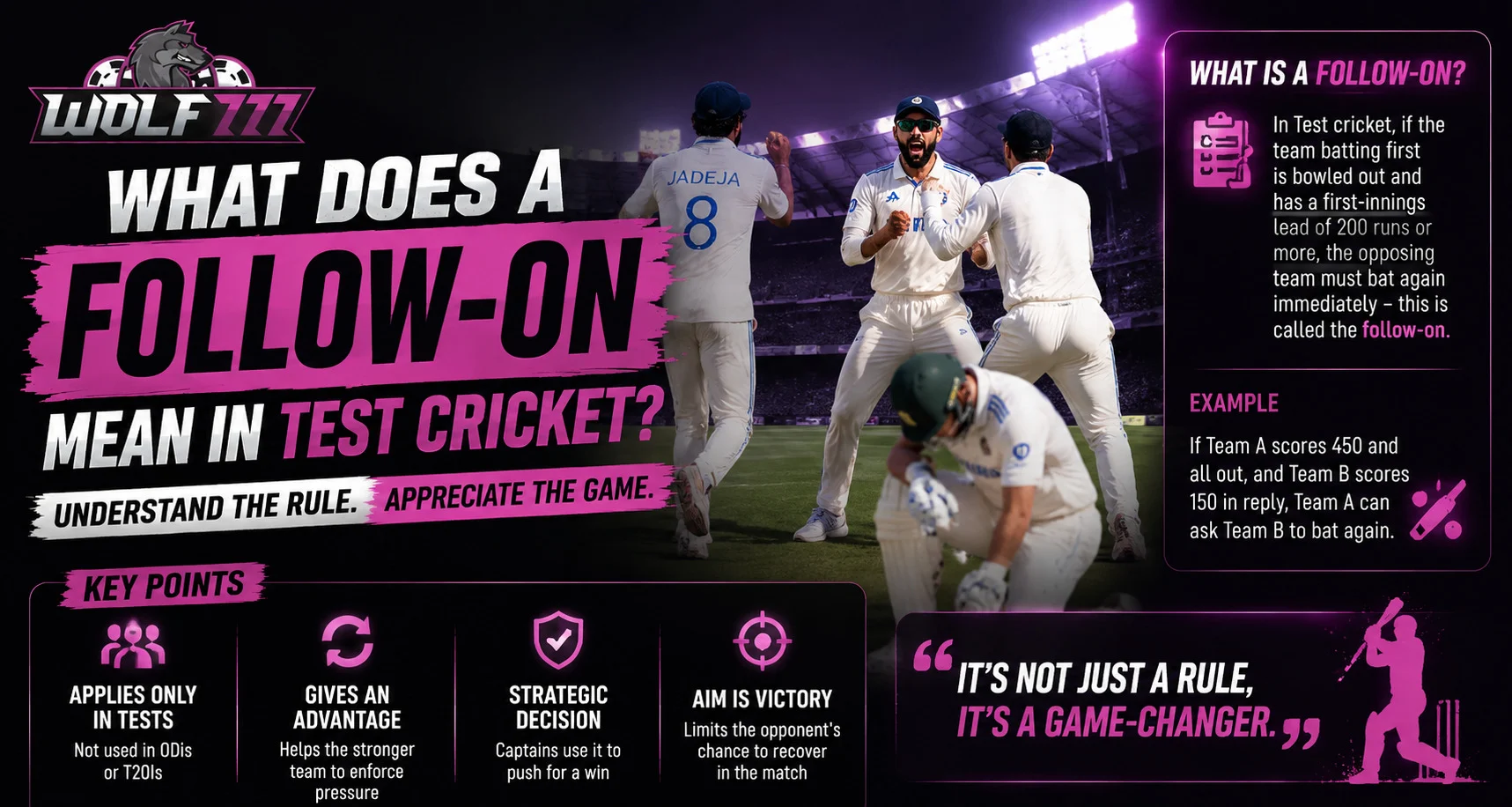
A follow-on occurs when the team batting second is asked to begin its second innings immediately after completing its first innings.
Normally, Test cricket follows this sequence:
- Team A bats.
- Team B bats.
- Team A bats again.
- Team B completes the match if necessary.
With a follow-on, the order changes:
- Team A bats.
- Team B bats.
- Team B bats again.
- Team A bats again only if required.
The rule is designed to give the team with a substantial first-innings advantage an opportunity to maintain pressure.
How Large Must the Lead Be?
In a standard five-day Test, the captain of the team batting first can enforce the follow-on when the first-innings lead reaches at least 200 runs.
The required margin can differ in shorter first-class matches depending on the competition’s playing conditions.
For example, if India scores 500 and Sri Lanka is dismissed for 290, India has a 210-run lead. India can therefore choose to enforce the follow-on.
Why Would a Captain Enforce It?
The main advantage is maintaining pressure on the opposition.
Instead of batting again immediately, the leading team can send the opposition back to the crease while it is still behind.
Potential advantages include:
- Keeping the opposition under pressure
- Saving time in the match
- Giving bowlers another opportunity
- Increasing the possibility of taking 20 wickets
- Creating a larger psychological challenge for the trailing team
However, enforcing the follow-on is not always the best choice.
Why Might a Captain Avoid It?
A captain may choose to bat again despite having a large lead.
This can provide the team with an opportunity to build an even bigger advantage.
Reasons for avoiding the follow-on can include:
- Giving bowlers additional rest
- Creating a larger fourth-innings target
- Taking advantage of a favourable batting pitch
- Reducing the risk of fatigue
- Protecting against a possible batting collapse
The decision depends heavily on pitch conditions, weather, time remaining and the strength of both teams.
What Happens After a Follow-On?
Once the follow-on is enforced, the trailing team begins its second innings immediately.
The goal is to erase the overall deficit and eventually give its opponent a target.
For example:
- Team A scores 550.
- Team B scores 300.
- Team A enforces the follow-on.
- Team B bats again.
If Team B scores 250 in its second innings, its combined total is 550, meaning Team A would not need further runs if the scores are exactly level. If Team B scores 300, Team A would need six runs to win.
Follow-On and Match Strategy
The follow-on can dramatically influence Test strategy.
The trailing team must concentrate on survival while also trying to reduce the deficit. Bowlers from the leading team may attack aggressively because taking wickets can bring victory closer.
Captains must also consider:
- Remaining overs
- Weather forecasts
- Pitch deterioration
- Bowler workload
- Required run rate
- Opposition batting depth
This makes the follow-on both a tactical and mathematical decision.
Does a Follow-On Guarantee Victory?
No.
There have been famous examples of teams being forced to follow on and still avoiding defeat or even winning. Test cricket can change dramatically over several sessions.
A team following on may:
- Recover with a large second-innings total
- Force a draw
- Set a challenging target
- Take advantage of deteriorating conditions
Therefore, enforcing the follow-on can create opportunities but does not guarantee success.
Why Is the Rule Important?
The follow-on gives the leading team another strategic option.
Without it, teams would always need to complete their second innings before the opposition could bat again. The rule allows a captain to use a substantial first-innings advantage to put immediate pressure on the opposition.
For users checking Wolf777 com for Test cricket information, understanding this rule can make match situations and scorecard changes easier to follow.
Follow-On and Live Match Understanding
When watching a Test live, look at the first-innings score difference.
If the team batting second is significantly behind, ask:
- Has the required lead been reached?
- Has the captain enforced the follow-on?
- How much time remains?
- Can the trailing team save the match?
- Are weather conditions likely to affect play?
These questions provide useful context when assessing the direction of the game.
Responsible Approach to Cricket Markets
Understanding cricket rules can help users interpret match developments, but no rule can predict the final outcome of a game.
Anyone using Wolf777 login should understand the relevant market information, follow applicable rules and avoid making decisions based purely on emotional reactions to a match.
Conclusion
The follow-on is a strategic rule that allows a team with a substantial first-innings lead to make its opponent bat again immediately. In a five-day Test, the usual threshold is a lead of at least 200 runs.
Although enforcing the follow-on can increase pressure and potentially save time, captains must carefully consider pitch conditions, weather, bowler workload and the remaining match time.
Understanding these factors makes Test cricket more interesting and helps fans follow the tactical decisions that can shape a match.
FAQs
What is a follow-on in Test cricket?
A follow-on occurs when the team that batted second is required to bat again immediately after its first innings because it has fallen sufficiently behind.
How many runs are required to enforce a follow-on?
In a standard five-day Test, the first-innings lead must normally be at least 200 runs.
Is enforcing the follow-on compulsory?
No. The captain of the leading team decides whether to enforce it when the required lead has been achieved.
Why might a captain refuse to enforce it?
A captain may want to rest the bowlers, build a larger lead or take advantage of favourable batting conditions.
Can a team win after being forced to follow on?
Yes. A follow-on does not guarantee victory for the team enforcing it. A trailing team can recover and change the course of the match.
Does the follow-on apply to every Test match?
The follow-on rule applies to Test cricket, with the required lead depending on the length and applicable playing conditions of the match.


