
Introduction
Race distance is one of the most important factors to consider when analysing a horse race. A horse that performs strongly over a short distance may not have the same advantage in a longer event. For racing fans following information through Wolf777, understanding how distance affects pace, stamina and strategy can make race analysis more meaningful.
Different distances require different physical qualities and tactical approaches. That is why comparing horses only by their previous finishing positions can sometimes provide an incomplete picture.
What Does Race Distance Mean?
Race distance refers to the total length horses must cover from the starting point to the finish line.
Depending on the racing format, distances can range from short sprints to longer endurance-focused events.
Distance can influence:
- Early pace
- Energy management
- Running style
- Stamina requirements
- Positioning
- Finishing speed
A horse’s previous performance should therefore be considered alongside the distance it raced over.
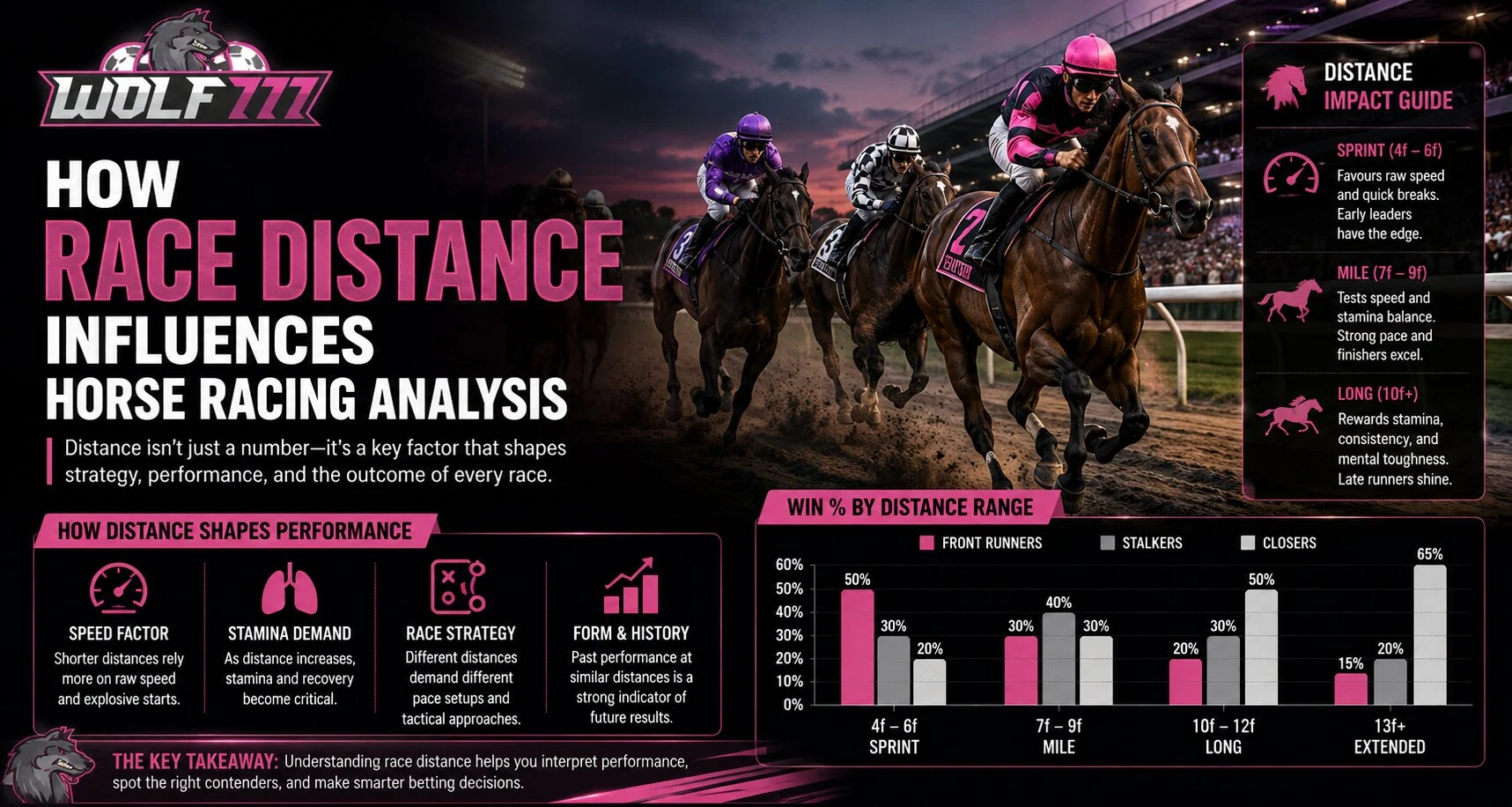
Sprint Races Require Early Speed
Short races usually place greater emphasis on acceleration and early speed.
There is less time for a horse to recover from a slow start, so positioning can become particularly important.
In shorter races, analysts may look at:
- Starting speed
- Early pace
- Reaction from the gates
- Ability to maintain speed
- Previous sprint performances
A horse that needs time to settle into its rhythm may find a short race more challenging.
Longer Races Test Stamina
Longer races require a different combination of abilities. Maintaining energy throughout the event becomes more important than producing maximum speed immediately.
Horses competing over longer distances may need:
- Strong stamina
- Controlled early pace
- Efficient movement
- Tactical patience
- A strong finishing effort
A fast start can sometimes become a disadvantage if too much energy is used before the final stages.
Pace and Energy Management
Race distance has a direct relationship with pace.
In a short race, competitors may be able to sustain a high tempo because the finish arrives relatively quickly. In a longer race, excessive early speed can create problems later.
This is why analysts often consider whether a horse’s previous races had similar pacing conditions.
For example, a horse that finished strongly after conserving energy over a longer distance may be more interesting in another endurance-focused event than its overall finishing position suggests.
Why Previous Results Need Context
A horse’s finishing position does not tell the entire story.
Consider two previous races:
- Horse A finished second over a similar distance.
- Horse B finished first over a much shorter distance.
The result alone does not establish which horse is better suited to the upcoming event.
Analysts should also consider:
- Previous race distance
- Track conditions
- Pace
- Starting position
- Competition level
- Finishing speed
Context can make historical results much more useful.
Track Conditions Can Change the Picture
Distance should not be analysed separately from track conditions.
Surface condition, weather and course characteristics can influence how much stamina or speed is required.
Factors to consider include:
- Firm or softer surfaces
- Course layout
- Inclines
- Turns
- Weather conditions
- Track maintenance
A horse that performs well on one type of surface may not reproduce the same performance elsewhere.
Running Style Matters
Horses can have different running styles, and distance can affect how useful each style becomes.
Some horses prefer to race near the front, while others settle behind the leaders before making a late move.
In longer races, a patient running style may allow a horse to conserve energy. In shorter races, a horse that can establish position quickly may have an advantage.
However, no running style is automatically superior. The race circumstances determine its effectiveness.
How Distance Changes Race Strategy
Jockeys may adjust their tactics according to the distance.
They might decide to:
- Establish an early position.
- Conserve energy during the middle stages.
- Avoid unnecessary battles for the lead.
- Move closer to the leaders at the right time.
- Produce a final acceleration.
The ideal strategy depends on the horse, competition and course.
What Fans Should Look For
For fans checking Wolf777 com for racing information, distance should be one part of a broader analysis.
Useful questions include:
- Has the horse raced successfully over this distance?
- Does its running style suit the event?
- How did it finish its previous race?
- What were the track conditions?
- Is the competition stronger or weaker?
- Does the horse appear capable of maintaining its pace?
These questions provide more useful context than relying on one statistic.
Responsible Approach to Racing Information
Horse racing involves uncertainty, and past performance does not guarantee future results. Fans should avoid treating race analysis as a prediction of a certain outcome.
Those using Wolf777 login should also protect their account credentials and never share passwords or verification codes with another person.
Conclusion
Race distance can significantly influence how a horse performs and how analysts should interpret previous results. Short races tend to place greater emphasis on speed and acceleration, while longer events can reward stamina, patience and energy management.
The strongest analysis considers distance alongside running style, track conditions, pace, competition and previous performances over comparable events. Understanding these factors can help racing fans develop a more balanced view of how different horses may approach a race.
FAQs
Why is race distance important in horse racing?
Distance influences the balance between speed, stamina and energy management, making it an important factor when comparing horses.
Are sprint horses suitable for longer races?
Not necessarily. Horses that specialise in short distances may struggle when asked to maintain their pace over longer events.
Why does stamina matter in longer races?
Longer races require horses to manage their energy over an extended period, making endurance an important performance factor.
Should previous race results always be compared?
Yes, but they should be compared in context, including distance, track conditions, competition and pace.
Does running style affect performance?
Yes. Front-running, stalking and late-running styles can have different advantages depending on race distance and course conditions.


