
Introduction
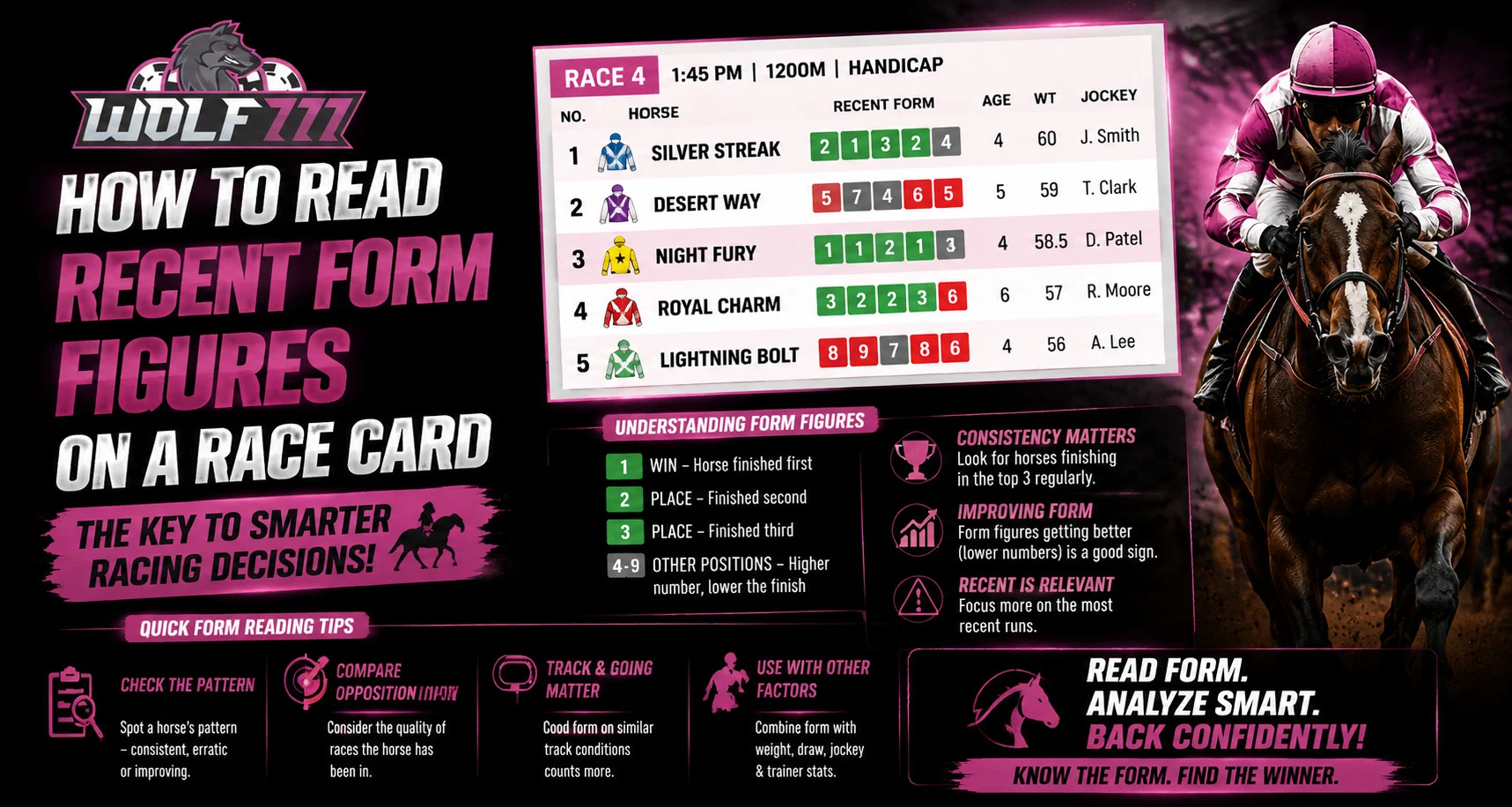
A race card contains useful information that can help readers understand a horse’s recent performances. One of the most noticeable sections is the sequence of form figures, which summarises where a horse finished in its previous races.
For readers exploring horse racing information through Wolf777, learning how to interpret these figures can make a race card easier to understand. However, form figures are only one part of race analysis and should be considered alongside other details.
What Are Form Figures?
Form figures are numbers or symbols showing a horse’s finishing positions in recent races. They are usually displayed in a sequence, allowing readers to quickly review previous results.
For example, a form line might look like:
2-4-1-6-3
This generally means the horse finished:
- Second in one race
- Fourth in another
- First in another
- Sixth in another
- Third in its latest or listed race, depending on the card’s ordering
The exact presentation can vary between race cards, so checking the card’s format is important.
Understanding Individual Numbers
The numbers are usually straightforward.
Common examples include:
- 1 – Finished first
- 2 – Finished second
- 3 – Finished third
- 4 – Finished fourth
- Higher numbers – Finished further back in the field
A sequence of low numbers generally indicates stronger recent finishing positions, while several high numbers may suggest less consistent results.
What Does a Zero Mean?
A 0 can appear when a horse finishes tenth or worse. It does not necessarily mean the horse failed to complete the race.
For example, a form sequence such as 1-0-5-2 could indicate that the horse won one race, finished tenth or worse in another, then placed fifth and second.
This is why reading the legend or explanation provided with the race card is useful.
What Do Letters Mean?
Race cards can also contain letters alongside numbers. These symbols can describe circumstances that affected the horse’s result.
Common examples include:
- F – Fell
- U – Unseated rider
- P – Pulled up
- R – Refused
- UR – Unseated rider, depending on the card’s notation
The meaning can vary slightly between racing jurisdictions, so readers should always check the race card’s key.
Which Result Should You Look At First?
The order of form figures is important.
Some race cards list the most recent performance first, while others use a different presentation. Before interpreting the sequence, check whether the card moves from newest to oldest or oldest to newest.
This prevents a common mistake: assuming the first number automatically represents the latest result.
Why Recent Form Matters
Recent results can provide a quick indication of how consistently a horse has been performing.
For example, a horse with figures such as 1-2-2-3 has shown a strong pattern of finishing near the front.
However, recent results should not be viewed in isolation.
A horse’s performance can change because of:
- Distance
- Going or track conditions
- Race class
- Field size
- Starting position
- Weight
- Jockey
- Course characteristics
These factors can explain why a horse’s recent results vary.
Look Beyond the Numbers
Form figures provide a summary, but they do not explain everything that happened during a race.
A horse may finish sixth after being blocked or racing wide, while another horse may finish third in a weaker field.
Therefore, readers should consider the wider race-card information.
Useful details include:
- Previous race distance
- Finishing margin
- Race class
- Track conditions
- Weight carried
- Jockey information
- Trainer record
This creates a more complete picture of current form.
How to Compare Two Horses
Suppose two horses have these recent records:
Horse A: 2-3-1-4
Horse B: 7-2-6-5
At first glance, Horse A has the more consistent finishing record. But that does not automatically mean it will perform better in the upcoming race.
The comparison should also consider whether the horses previously competed over similar distances and under comparable conditions.
Why Distance Matters
A horse may perform strongly over one distance but struggle when moved to another.
For example, a horse with several good results over shorter races may not reproduce the same form over a longer distance.
When reading a race card, compare previous distances with the upcoming race.
Why Track Conditions Matter
Track or going conditions can also affect form.
A horse may have strong results on firm ground but weaker performances on softer conditions. Looking only at the finishing numbers could hide this important difference.
Checking previous performances under similar conditions can therefore provide additional context.
Form Figures Are Not a Guarantee
Recent form is useful information, but it cannot predict a race with certainty.
Horse racing contains many variables, including:
- Pace
- Traffic
- Weather
- Positioning
- Fitness
- Competition
- Race tactics
A horse with excellent recent figures can still have a poor performance, while an inconsistent horse can improve unexpectedly.
A Simple Way to Read a Race Card
When reviewing form figures, use this basic process:
- Identify the latest result.
- Check the previous three to five performances.
- Look for consistent finishing positions.
- Check the distances of those races.
- Compare the track conditions.
- Review race class and field strength.
- Consider the jockey and weight.
- Read any notes about unusual performances.
This approach gives more context than simply counting wins.
Conclusion
Form figures are one of the quickest ways to review a horse’s recent racing history. Numbers such as 1, 2 and 3 show finishing positions, while symbols and letters can provide additional information about how a race ended.
For readers checking Wolf777 login and following race-card information, the most useful approach is to treat recent form as a starting point rather than a final prediction.
By combining form figures with distance, conditions, race class, weight and other race-card details, readers can develop a clearer understanding of how a horse has been performing.
FAQs
What do form figures mean on a race card?
Form figures usually show a horse’s finishing positions in its previous races.
What does the number 1 mean in horse racing form?
The number 1 generally means the horse finished first in that particular race.
What does 0 mean in race form?
A 0 commonly indicates that the horse finished tenth or worse, although the exact notation should be checked on the relevant race card.
Are recent form figures enough to assess a horse?
No. Distance, track conditions, race class, weight, jockey and other factors should also be considered.
Why should I check the order of form figures?
Race cards can display results in different orders. Checking the card’s format helps identify which result is the most recent.


